• Skip to primary navigation
  • Skip to main content
  • Skip to primary sidebar
  • Skip to footer
  • Mesa Office (480) 325-3310
  • Gilbert Office (480) 633-0666

Farnsworth Orthopedic Physical Therapy

Orthopedic Physical Therapy

  • Meet Our Therapists
  • Blog
  • What We Treat
  • See What Our Patients Say!
  • FAQs
  • Contact Us
  • New Patient Forms

piriformis syndrome

Piriformis Syndrome

June 15, 2022 by Gabby

If you’re struggling with a chronic pain in the butt, relief can be hard to find. This is true especially if you have piriformis syndrome. The dead giveaway that this is the problem you’re dealing with is hip and/or buttock pain on one side of the body along with low back pain that radiates down one or both of your legs.

What are we talking about?

Your sciatic nerve travels through your pelvis. It passes under the front surface of the piriformis muscle as it travels through the pelvis. It then cuts into two branches before going down each leg, branching out at the back of your knee to divide into the tibial and peroneal nerves. These nerves supply your lower leg and foot.

On the other hand, your piriformis helps externally rotate and abduct the hip. This is fancy talk for turning your hip outward and bringing your thigh outward while your hip is bent. For example, when your raise your knee and bring your leg out when getting out of a car. It also offers stability while you walk, run and stand.

Piriformis or Sciatica?

The problem is, piriformis syndrome is often mistaken for sciatica. Both conditions interfere with sciatic nerve function. Sciatica results from spinal dysfunction such as a herniated disc or spinal stenosis. Piriformis syndrome, happens when the piriformis muscle, located deep in the buttock, compresses your sciatic nerve. Your therapist is trained to be able to tell the difference. They will help you figure out what is going on and how best to treat it.

Let’s Treat It

We can treat piriformis syndrome through a combination of hands-on manual therapy techniques and an exercise program. Myofascial release of the piriformis muscle along with a stretching exercise can help relieve tightness and pain directly related to the piriformis. In addition to direct treatment of the piriformis, your physical therapist will address the underlying cause of piriformis syndrome. They may treat muscle imbalances of your hip and address lumbar spine issues.


If you feel this particular pain in the butt, come in and see us soon and we will have you feeling much better.


Written by Tom Farnsworth PT

Filed Under: pain, piriformis syndrome, sciatica, treatment, Uncategorized

Piriformis Syndrome

November 11, 2019 by Gabby

The Piriformis muscle is located in the buttocks area, underneath the gluteus maximus. It’s one of the muscles that helps rotate the thigh bone outward, like you do when you cross your ankle over your knee. The muscle runs from the tail bone and attaches at the hip bone.The sciatic nerve is a major nerve that begins in the low-back area and travels down the back of the thigh and continues down, branching off in the lower leg and foot. The sciatic nerve usually runs directly through the Piriformis muscle, although it may lie above or under the Piriformis.
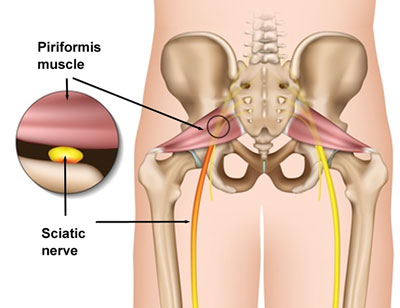
The cause of Piriformis Syndrome is not entirely clear and may be a result of several different things. It is often associated with sacroiliac (SI) problems. Trauma, such as falling on the buttocks may incite the symptoms. Extended sitting can be a factor, as in the case of professional drivers or office workers. Other problems, such as hip bursitis, back strains, or gluteal tendonitis may bring on the condition.

Symptoms include pain and tenderness in the buttocks area. The problem may be on one or both sides. Sitting is often uncomfortable. Walking, running, and climbing or descending stairs is often painful. In some cases radiating pain may shoot down the back of the thigh and into the lower leg because of irritation to the sciatic nerve.

There are many treatment options for Piriformis Syndrome. Moist heat can help relieve and control pain. Ultrasound may be beneficial since it is a method of deep heating. Certain therapeutic exercises may greatly help to recondition the muscle. There are several stretches for the muscle that can help relieve the tightness. Avoidance of irritating factors is crucial. Manual techniques such as soft tissue mobilization are often helpful. In severe cases, anti-inflammatory injections may be needed.

With proper treatment and follow through, this condition can be resolved. In some cases it will resolve quickly, while in others it may be a lengthy rehabilitation. For more information consult your physical therapist.

Post written by Travis Rohner, DPT

Filed Under: desk job, pain, piriformis syndrome, sciatica, treatment Tagged With: back pain, leg pain, piriformis, sciatica

Primary Sidebar

Categories

  • back
  • desk job
  • fall risk
  • feet
  • health
  • home exercise
  • knee
  • knee pain
  • lateral epicondylitis
  • lifting
  • pain
  • piriformis syndrome
  • posture
  • sciatica
  • shoulder
  • sleep
  • treatment
  • Uncategorized
  • welcome

Recent Posts

  • Fire and Ice
  • Plantar Fasciitis
  • Achilles Heel
  • Piriformis Syndrome
  • Weird Flexors? Okay.

Footer Insurance

We accept most insurances!

See a list of our preferred providers.

Footer

Common Ailments & Injuries

50 years of experience has brought us a lot of patients, with a wide variety of problems. We have experience diagnosing and treating all types of injuries, but here are some of the most common:

  • Ankle and Foot
  • Back and Neck
  • Elbow
  • Hand and Wrist
  • Hip
  • Knee
  • Shoulder

What Our Patients Say:

We love working with people and always want our patients to feel like part of our family when they are here. Read what some of them have said about their experience with us.

Patient reviews


Sub Footer

Areas Served:

Mesa, Gilbert, Chandler, Phoenix, Queen Creek, Apache Junction, Tempe, Globe, Gold Canyon

Postal Address

Gilbert Office
730 N. Greenfield Rd.
Gilbert, AZ 85234

Phone: (480) 633-0666

Mesa Office
342 N Val Vista Dr. Suite 106
Mesa, AZ 85213

Phone: (480) 325-3310

FoptAZ.com

  • Home
  • Meet Our Therapists
  • Blog

© 2025 All Rights Reserved Farnsworth Orthopedic Physical Therapy