• Skip to primary navigation
  • Skip to main content
  • Skip to primary sidebar
  • Skip to footer
  • Mesa Office (480) 325-3310
  • Gilbert Office (480) 633-0666

Farnsworth Orthopedic Physical Therapy

Orthopedic Physical Therapy

  • Home
  • Reviews
  • FAQs
  • Contact us
  • Meet Our Therapists

pain

Deep Vein Thrombosis

August 8, 2021 by Julie

DVT

Deep vein thrombosis (DVT) is caused by a blood clot (thrombus) forming in one or more of the deep veins in your body, most commonly in your legs. Deep vein thrombosis can cause swelling and/or pain, but also can occur without any symptoms.

Certain medical conditions that affect how your blood clots can make you more susceptible to getting a DVT. A blood clot in your legs can also happen if you don’t move for a long time, such as after you have surgery or an accident, when you’re traveling a long distance, or when you’re on bed rest.
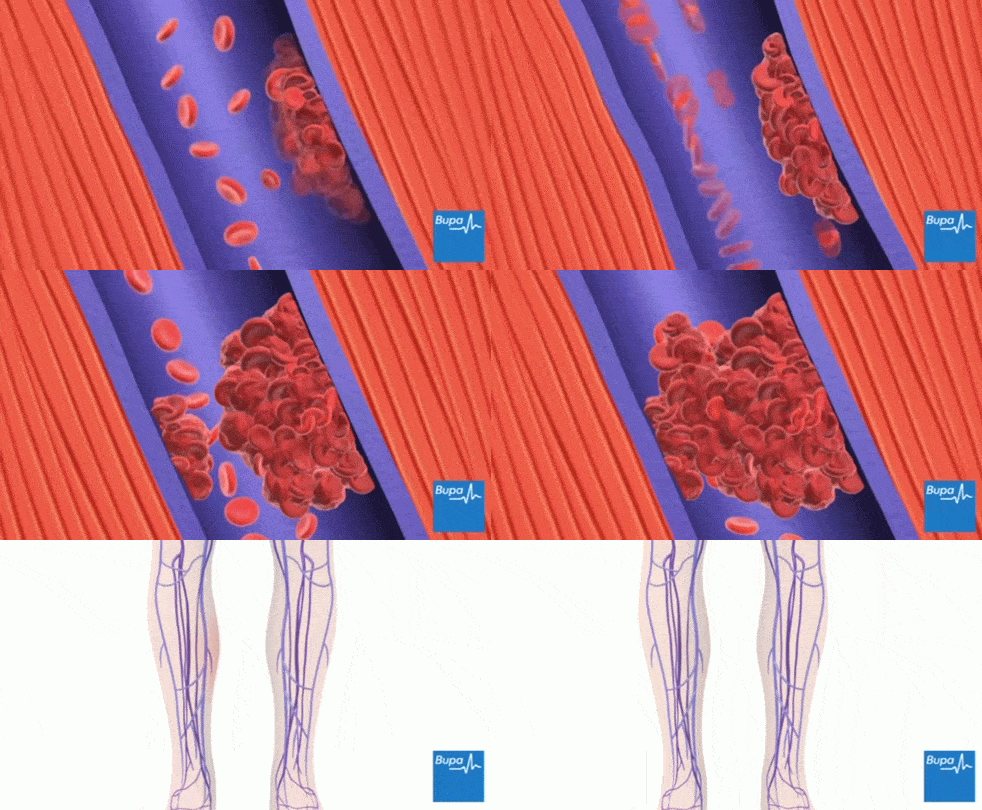
Deep vein thrombosis can be very serious because blood clots in your veins can break loose, travel through your bloodstream and get stuck in your lungs, blocking blood flow (pulmonary embolism). However, pulmonary embolism can occur with no evidence of DVT.

When DVT and pulmonary embolism occur together, it’s called venous thromboembolism (VTE).

Symptoms

DVT signs and symptoms can include:

  • Swelling in the affected leg. Rarely, there’s swelling in both legs.
  • Pain in your leg. The pain often starts in your calf and can feel like cramping or soreness.
  • Red or discolored skin on the leg.
  • A feeling of warmth in the affected leg.
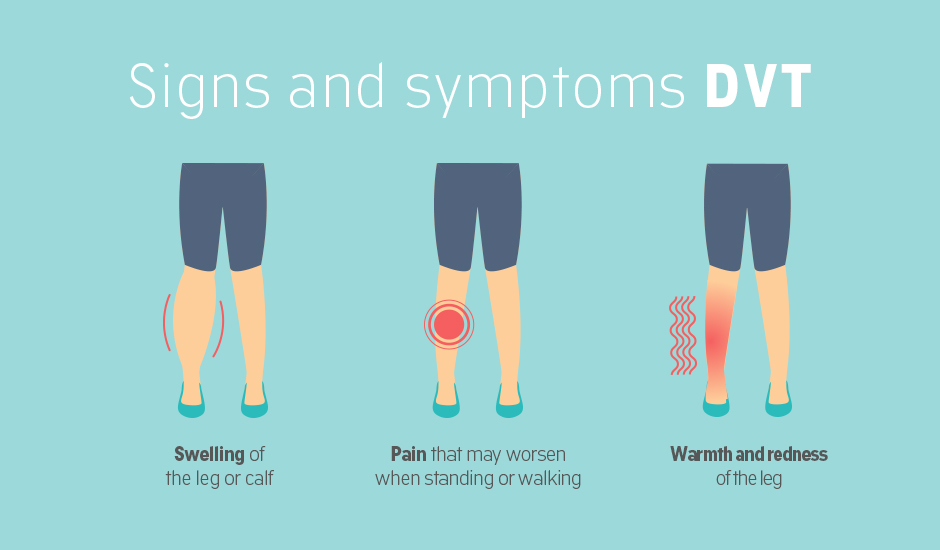
Deep vein thrombosis can occur without noticeable symptoms.

Prevention

Measures to prevent deep vein thrombosis include the following:

  • Keep Moving! If you have had surgery or have been on bed rest for other reasons, try to get moving as soon as possible. If you’re sitting for a while, don’t cross your legs, which can block blood flow. If you’re traveling a long distance by car, stop every hour or so and walk around.
  • If you’re on a plane, stand or walk occasionally. If you can’t do that, exercise your lower legs. Try raising and lowering your heels while keeping your toes on the floor, then raising your toes with your heels on the floor.
  • Don’t smoke. Smoking increases your risk of getting DVT.
  • Exercise and manage your weight. Obesity is a risk factor for DVT. Regular exercise lowers your risk of blood clots, which is especially important for people who sit a lot or travel frequently.

Don’t smoke and end up like Kramer.


Written by Clint Bunker PT
Filed Under: pain, treatment

Bye Bye Bicep!

June 20, 2021 by Julie

The “Bi” in Bicep

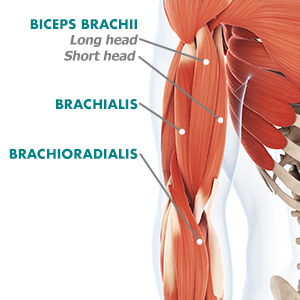
The front part of the upper arm is known as the bicep muscles. It consists of the coracobrachialis, brachialis and the biceps brachii. These muscles collectively will help flex the elbow and raise your shoulder up in front of your body. The most common muscle of these is the bicep brachii. It consists of two heads, hence the word “bi”. The long and the short head attach in different locations but are both effective for arm movements. Biceps are known as aesthetic muscles. However, the biceps also serve a functional purpose for everyday activity. Like other muscle tissue in the body, they can also have overuse injuries as well as traumatic injuries from these activities.

Injury

Overuse injuries are common in these muscles. They can occur in your shoulder or further down in your elbow area. Common overuse injuries occur in athletes such as overhead throwers, golfers, swimmers, and tennis players. It can also occur in non-athletes with repetitive movements. Work related duties or weakness in your rotator cuff area cause injuries too. It is important to avoid or limit movements that may have caused the injury as well as agents to help the localized swelling including ice and NSAIDs or injections. Physical therapy services can also provide relief to localized area as well as help change mechanics to prevent further injury going forward.

(We can’t all be the hulk)

A bicep tear can also occur in the shoulder or elbow attachment as well. A prolonged overuse injury, fall on an outstretched arm, or rapid twisting movement of the elbow and/or shoulder can be problematic. This can tear the bicep either partially or completely. Lifting a heavy object can also cause a bicep tear. This happens most commonly at the distal attachment. Complete tears will cause the muscle to roll into the mid arm, looking something like Popeye in the old cartoons. A partial tear may not visually be identified. Increased pain and weakness in your bicep as well as a “pop” during the activity are good indications of a tear in your bicep. These issues are typically resolved with surgical intervention followed by physical therapy to help restore normal function of the elbow and shoulder.

Recovery

Physical therapy is such an integral part of recovery for a bicep injury. Before or after a surgery, it’s  important to keep the shoulder healthy to prevent one of these injuries. If you feel that you have an issue with your bicep, feel free to contact our office to see how we can help you.

Written by Casey Badder, PT

Filed Under: lifting, pain, treatment

Don’t Hurt Yourself Sleeping

May 27, 2021 by Julie

The Sad Truth

When you slide into bed at the end of a long day, you might not think much about your sleep position.  But the way you choose to lay down on your bed can have a major effect on how you feel.  Can you actually injure yourself sleeping? The sad truth is, yes.

Ever noticed how you feel achy and painful after a night sleeping on a mattress you thought was great? If so, you have become a victim of a sleep injury. Even on the best mattresses in the world, a bad sleep position can cause injury. And although a great mattress can help you sleep in a better position, it cannot guarantee a pain-free morning if you aren’t sleeping in a way that is best for your body.  You’ve probably heard of something called a “crick” in your neck or back. “Cricks” sound like a mild annoyance, but they can actually be pretty serious. If you aren’t careful, you can injure yourself and create more wear and tear on your body.

Possible Pains

Shoulder Pains – Do you put your arm underneath your head as a pillow when you sleep? This could actually wear down the cartilage of your joint, and can lock your shoulder muscles in place – making them very painful when you try to straighten your arm in the morning.


Back Pains – Sleeping incorrectly on your back can cause you to strain those muscles. You may have already worn a you-shaped groove into the mattress, and the depression in the mattress will pull on your back muscles. In certain cases this can actually cause your spine to slip out of alignment if you don’t change your mattress or your sleeping position.

Elbow Injuries – Does your arm hang over the edge of your bed as you sleep? When you sleep on your back, do you extend your arms straight out to the side? If so, you may be placing extra strain on your elbows. You may actually cause the same kind of injury you can get by working out incorrectly, as placing all of the weights on your elbow joint can hyperextend the joint – causing potentially serious damage.


Neck Pains – If you sleep on your stomach, your neck has to twist at a weird angle. If you sleep on your back, a pillow that is too thick can strain the curvature of your spine and your neck muscles. If your pillow is too thin, side-sleeping can strain the muscles on the side of your neck.

Hip Pains – Those that sleep on their side may be used to it, but those trying to change their position from stomach or back-sleeping to side-sleeping may feel pains in their hips. Sleeping on your side without the right support can actually wear down your hip joints.

There’s Hope

Look at how you sleep, as well as how you feel when you wake up in the morning. If you feel aches and pains, it may be time to change your sleeping habits!  If you’ve hurt yourself sleeping, there’s hope.  Come and see us during your waking hours and we can help you heal.


Filed Under: pain, sleep

Exercise- For Your Health

May 11, 2021 by Julie

Exercise is good for your body.  This is a fact that most people realize.  Getting exercise regularly can aid in weight loss and help strengthen your muscles and bones. However, there are more reasons why exercise may be something you want to take seriously. At the top of the list are the mental health benefits that happen when you work out.

Self-Esteem

Exercising helps to build your self-esteem by improving how your body moves, feels and looks. Even if you don’t lose weight from exercising, you are likely still strengthening your muscles and helping your body to move as it should. It can be empowering to run longer, lift heavier weights and stretch farther than you used to.  These physical results will make you feel better, and improve your confidence and self-esteem.

Pain

Scientific studies have shown that people who exercise and stay flexible are better able to manage their pain than those who don’t. Typically, chronic pain can lower your pain threshold. This means it takes less pain to cause you discomfort. Fortunately, exercise helps to increase your pain threshold. Increasing blood flow through your body helps your joints and muscles move more freely, and that helps decrease your pain.

Brain Power

Exercise enhances blood flow throughout your body, and that includes your brain. This increased blood flow supports the survival of new neurons in your brain and helps other neurons fire up faster. Exercise has been shown to promote neurogenesis, which allows for the creation and survival of new brain cells in the brain. This allows for better cognitive function, memory recall and more creativity.

Positive Mood

There is a strong link between exercise and the treatment of mild to moderate anxiety and depression. Exercise encourages all kinds of positive changes in your body by releasing endorphins in your brain such as dopamine, serotonin and oxytocin. These are known as the “feel good” chemicals because of their strong influence on your mood.  Getting regular exercise can be a huge help in managing your mood.

(That’s his positivity face.)

Stress

When you work out, you actually give your mind a chance to slow down and stop thinking about the things that stress you out. Pair this with the better sleep that comes as a result from exercising and you will see a significant reduction in your stress levels.

Do What You Can

There are so many different ways you can get exercise, ranging from weight lifting to yoga. No matter what type, doing some is better than doing none. Do what you can and not only will you reap the benefits physically, but mentally as well.

Filed Under: home exercise, pain, sleep

Trigger Finger

May 4, 2021 by Julie

What is it?

Trigger finger is when your fingers or thumb get stuck in a bent position – as if squeezing a “trigger.” Trigger finger  occurs in just one or possibly more than one finger. Usually, your ring finger is the trouble finger. The condition is also known as stenosing tenosynovitis for all of you physical therapy fans out there.

Wrong kind of trigger finger.

Who does it happen to?

We see trigger finger most commonly in:

  • People who have jobs, hobbies, or tasks that require strenuous repetitive motions; frequent, strong grasping or gripping, or forceful use of the fingers and/or thumb.
    • Farmers
    • Industrial workers
    • Musicians
    • Gamers
  • People who have osteoarthritis, rheumatoid arthritis, gout, or diabetes
  • People between the ages of 40 and 60.

Keyboard cat would be high risk for trigger finger, but alas, he has no fingers.

Symptoms and Causes

Tendons are bands of tissue that attach your muscles to your bones. In your hand, tendons and muscles must work together to flex and straighten your fingers and thumb. Usually, tendons slide easily through a tunnel of tissue called a sheath. The sheath keeps the tendons in place next to the bones of the finger(s) or thumb. With trigger finger or trigger thumb, your tendons become irritated and swollen and can no longer easily slide through their sheaths. A bump may also form on the tendon, which makes it even more difficult for the tendon to easily glide through its sheath.

Signs and symptoms of trigger finger or trigger thumb include:

  • Snapping or popping sensation when moving the finger(s) or thumb.
  • Soreness at the base of the finger or thumb in the palm, especially while gripping or grasping.
  • Pain and stiffness when bending the finger or thumb.
  • Swelling or tender lump in the palm of the hand.
  • Locking of the finger or thumb in the bent position (in severe cases). Your finger or thumb has to be gently straightened using your other hand.
  • Inability to fully flex the finger.

The stiffness and bent position of your finger or thumb are worse in the morning. The stiffness typically lessens as you use your fingers.

Management and Treatment

For mild cases, the first step is to rest the finger or thumb and limit or avoid the activities that are causing symptoms. Sometimes a splint may be used on the affected finger to keep the joint from moving. If symptoms continue, anti-inflammatory medications, such as ibuprofen, may be prescribed or steroid injections may be considered.

If the condition does not respond to non-surgical treatments or continues to recur, then we will recommend surgery.

Written by Clint Bunker PT

Filed Under: pain, treatment

All Is Swell That Ends Swell

April 27, 2021 by Julie

Swelling is a natural part of your body’s healing process after an injury. When your body needs to heal an injury, it will make it swell by sending blood, lymphatic fluid and special repair cells to the injured area. Too much swelling, on the other hand, or swelling that lingers too long, can slow your recovery by making the injured area more painful and less mobile. So, what can you do to keep yourself at a healthy level of swelling?

(This dog is swelling because he ate a bee.  Do not be like this dog.)

The first resource you have is compression. Compression is very effective. It can be achieved various ways. The most common way to compress a swollen limb is to wrap an ace bandage around it. When you wrap an injury it’s helpful to “grade” the pressure.  That means that you need to make the wrap tighter close to the injury and looser on the end closer to your heart.  Also, compression garments offer a convenient form of compression.  These can be worn all day which can help them be more effective. Most running or athletic stores sell knee-high compression socks for athletic performance that can also be used to manage swelling. These are great if your swelling is in your ankles or lower legs.


Another major way to work on swelling is through muscle pumping. Your veins, the vessels that bring blood BACK to the heart, rely on the pumping action of your muscles to move blood back toward your heart. Veins have valves that prevent back-flow but the real action comes when we use our muscles.Your lymphatic vessels also rely heavily on the muscle pump. Long story short, you can help your body get rid of excess swelling by contracting your muscles.  The way you do that is by using them! Exercising the muscles around the swollen area is critical to getting rid of swelling.

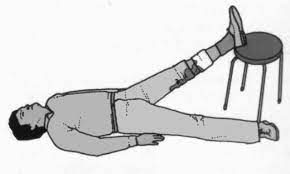
Elevation is another tool you can use.  Have you ever noticed that swelling improves first thing in the morning and gets worse throughout the day? When you’re sleeping at night, you’re in a gravity-neutral position, so it’s easier for your body to process the swelling. Throughout the day, gravity pulls the swelling back into your limbs. Elevation is the least effective tip on this list. This is partly because elevation really only works if your swollen limb is ABOVE YOUR HEART. Plus, elevation is usually not very active, and activity and pumping of your muscles. But if you can make sure to elevate the injury above your heart, it can be one more swelling trick up your sleeve.

(This guy has got his injury above his heart.  He gets points for that.  But maybe find a more comfortable place to lay down.)


Your last major weapon against swelling is ice.  Ice is especially helpful in the first 24-48 hours after an injury. The cold from ice causes vasoconstriction (narrowing of the vessels) which helps push the swelling out. Another benefit of ice is its analgesic effect. Ice can really help reduce your pain level. If you have pain and swelling, ice is going to come in handy.  Apply ice for 10-15 minutes.  Make sure to put a barrier like a cloth or pillowcase between the ice or ice pack and your skin.  Frostbite is not something that anyone wants.

(Elsa is icing and elevating, she gets it.)


These are some resources you can use at home.  If you have a serious injury, see a doctor, and see us for physical therapy.  We have added techniques and targeted exercises that can help you heal quickly and safely.


Filed Under: home exercise, pain, treatment

  • Page 1
  • Page 2
  • Page 3
  • Interim pages omitted …
  • Page 7
  • Go to Next Page »

Primary Sidebar

Categories

  • back
  • desk job
  • fall risk
  • feet
  • health
  • home exercise
  • knee
  • knee pain
  • lateral epicondylitis
  • lifting
  • pain
  • piriformis syndrome
  • posture
  • sciatica
  • shoulder
  • sleep
  • treatment
  • Uncategorized
  • welcome

Recent Posts

  • Blood Flow Restriction Training
  • Pool’s Gold
  • Deep Vein Thrombosis
  • Plantar Plate Tear
  • I Have a (Shoulder) Hunch…

Footer Insurance

We accept most insurances!

See a list of our preferred providers.

Footer

Common Ailments & Injuries

50 years of experience has brought us a lot of patients, with a wide variety of problems. We have experience diagnosing and treating all types of injuries, but here are some of the most common:

  • Ankle and Foot
  • Back and Neck
  • Elbow
  • Hand and Wrist
  • Hip
  • Knee
  • Shoulder

What Our Patients Say:

We love working with people and always want our patients to feel like part of our family when they are here. Read what some of them have said about their experience with us.

Patient reviews


Sub Footer

Areas Served:

Mesa, Gilbert, Chandler, Phoenix, Queen Creek, Apache Junction, Tempe, Globe, Gold Canyon

Postal Address

Gilbert Office
730 N. Greenfield Rd.
Gilbert, AZ 85234

Phone: (480) 633-0666

Mesa Office
342 N Val Vista Dr. Suite 106
Mesa, AZ 85213

Phone: (480) 325-3310

FoptAZ.com

  • Home

© 2026 All Rights Reserved Farnsworth Orthopedic Physical Therapy