• Skip to primary navigation
  • Skip to main content
  • Skip to primary sidebar
  • Skip to footer
  • Mesa Office (480) 325-3310
  • Gilbert Office (480) 633-0666

Farnsworth Orthopedic Physical Therapy

Orthopedic Physical Therapy

  • Meet Our Therapists
  • Blog
  • What We Treat
  • See What Our Patients Say!
  • FAQs
  • Contact Us
  • New Patient Forms

PAIN

Happiness is A Warm Theragun

December 26, 2019 by Gabby

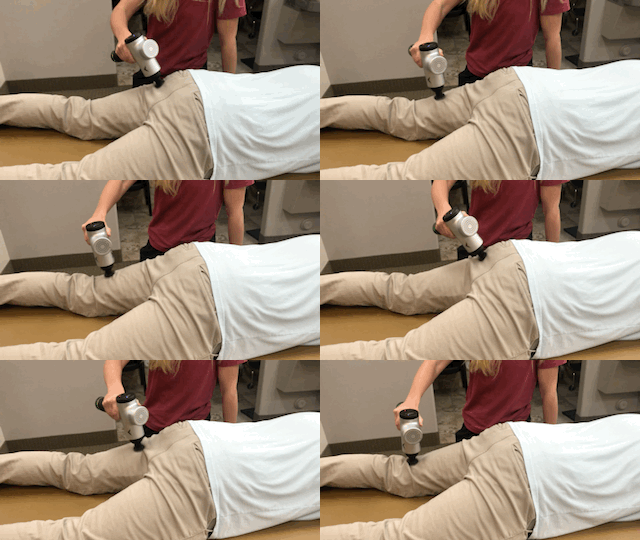
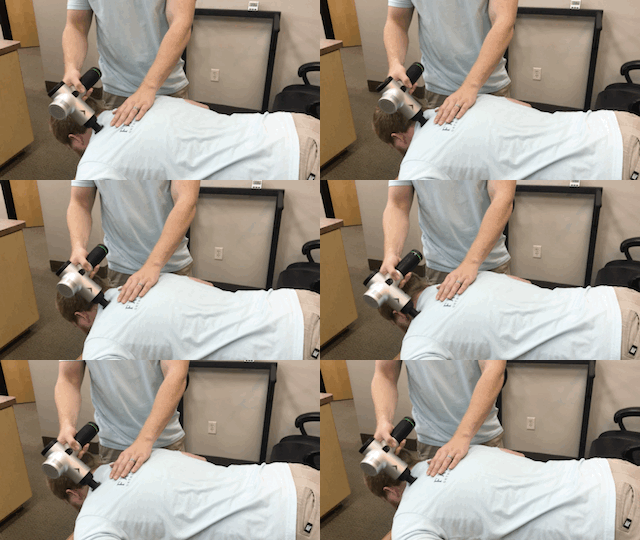
One of the “weapons” that our therapists have in their arsenal is the Theragun. Shaped like an electric drill, the Theragun is a tool that takes aim at muscle tension, zaps knots, and blasts through scar tissue. At the tip of the Theragun is one of several specialized heads that target your muscles with strong percussion. There are small tips that pinpoint trigger spots, and broad tips for larger areas like your back.

Wherever you’ve got pain, the Theragun delivers powerful percussion to relax your muscles and increase blood flow to the area. The vibrations stimulate your nerves enough that they stop sending signals for pain. Translation? You don’t hurt so much. If you smash your finger, you may immediately shake your hand around, stimulating your hand in a way that isn’t painful in hopes that you feel the shaking instead of the awful pain of a smashed finger. Likewise, when you have muscle pain, the Theragun is there to shake things up and get your nerves busy sending signals for something other than pain.

Additionally, your muscles have a casing around them called myofascial tissue. Sometimes this tissue can get tight and inflexible, kinked, or overlapped onto itself. This can lead to widespread muscle pain. Loosening this tissue and making it flexible again can increase flexibility and relieve pain. This release is an important part of recovery. The Theragun is a useful tool to work on trigger points that create myofascial release.

Lastly, it just feels nice and relaxing. Who wouldn’t want some percussive vibrations on their sore muscles? There may be some of us who might not. A Theragun is not the right tool for those who have injuries that are too recent. It also may not be the right option for patients who have certain conditions above the shoulders or who have had certain operations. Getting evaluated by a licensed therapist will help you to know if this therapy is right for you. If it is, you will soon be on your way to a more relaxed, flexible, and pain free you.

Post Written By: Tom Farnsworth, PT
Filed Under: pain, treatment Tagged With: low back pain, neck pain, PAIN, theragun, treatment

Frozen Shoulder

November 25, 2019 by Gabby

Cooler temperatures during fall months remind us that winter is coming. While we don’t have to deal with freezing conditions here in Arizona,  there are some “frozen” things we can experience.  Some of these things are enjoyable-the beloved Disney film, yogurt, pizza, bananas- and some are not- a frozen bank account, for example, and a condition known as “Frozen Shoulder.”

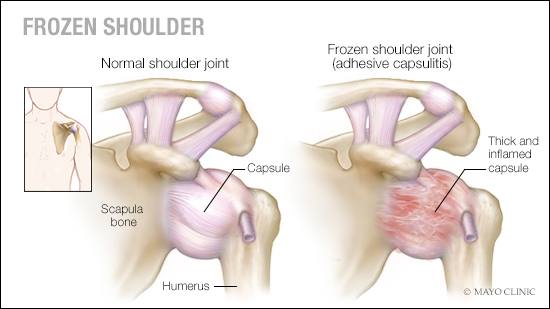
The official name for frozen shoulder is Adhesive Capsulitis. The main symptom of this condition is a stiff shoulder joint, which affects range of motion. Not only is this very inconvenient, it’s also painful. Frozen shoulder is most common in women, aged 35-60, but men are not immune to it. Diabetes, thyroid conditions, and trauma can make someone more prone to developing this condition. If left alone, the pain and lack of mobility will eventually resolve themselves, but it can take years.

There are three stages of frozen shoulder. First, we have the freezing stage. In this stage, pain increases as range of motion begins to decrease. This stage can last up to several weeks. Next, we have the frozen stage where pain continues, especially with movement.  Adhesions start to form, making the tissues stick together, further limiting the motion. Separate problems
develop, especially muscle imbalances. Finally, we have the thawing stage. Stiffness and pain continue, but you will see gradual improvement. This final stage can last anywhere from several weeks to over a year.

Olaf, before physical therapy.

Physical therapy applied at each stage can significantly reduce healing time. One of
the most important things is a proper stretching routine, both in office and at home. Manual therapy will also be part of your recovery. It’s important to discuss your recovery process with a physical therapist. Doing so will reduce the risk of worsening your injury in any way. If you think you may have frozen shoulder, make an appointment to be evaluated. We would love to help you heal.

Olaf, after physical therapy.

Post written by: Rod Walker, DPT


Filed Under: shoulder Tagged With: frozen shoulder, PAIN, treatment

Put Your Best Foot Forward

October 7, 2019 by Gabby

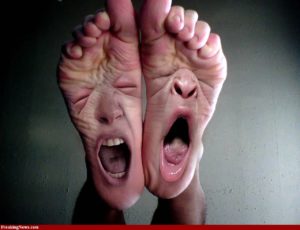
Plantar fasciitis is a condition that affects the bottom or sole of the foot. The plantar fascia consists of several broad bands of thick, tough tissue, which start at the bottom of the heel bone (called the calcaneous). Some of the bands attach to the underside of the bones of the forefoot. The others attach to the bottom of the foot at the ball of the foot (called the metatarsal heads). Because these bands are very close together, they are generally called the plantar fascia.

The plantar fascia provides a structural reinforcement for the foot and helps maintain the arch of the foot. Plantar fasciitis is a condition that happens when the plantar fascia becomes irritated and inflamed. This inflammation can have many causes such as overuse (too much running, walking or standing) or trauma (stepping on a stone, falling on the heel, etc.). Another cause may be a heel spur, which is a bony spur on the bottom of the heel usually located where the plantar fascia attaches. In some rare cases, inflammatory disease may be the cause.

The main symptom is pain located on the sole of the foot. The pain may be very local, in one precise spot, or it may be generalized. Most often, it seems to be at the base of the heel bone or middle of the arch. The problem may be in one or both feet. Pain usually is present or worsens with weight-bearing activities such as walking or standing.

Treatment can take many forms. One of the first interventions is to insert a heel-pad support in the shoes to take some of the pressure off the attachment of the plantar fascia. If the pain is near the metatarsal heads, there are also shoe-insert pads for this area. Heat can help to relieve the discomfort. Ultrasound can help reduce the inflammation. Additionally, there are specific stretches and therapeutic exercises that can be performed to help improve the condition. As the symptoms resolve, rehabilitation generally progresses into more functional-activity exercises, such as walking. For more information consult your health professional.

Post written by: Travis Rohner, DPT

Filed Under: feet Tagged With: feet, foot pain, PAIN, plantar fasciitis

Thank You, Necks

September 8, 2019 by Gabby

Even genies get cervicalgia!

Many neck injuries and conditions can cause pain extending down into one or both of the arms. This radiating pain is called cervical radiculopathy. Problems in the cervical (aka neck) region may cause irritation and inflamation to the nerves located there. Because these nerves run down the arms and hands, it is normal for the brain to perceive the pain as originating there, even though the problem is in the neck.

There are three main nerves in the arms: median, ulnar, and radial. Each of these nerves originates at certain levels in the neck. The location of the pain in the arm may indicate where the problem lies in the neck.  One cause of cervical radiculopathy is degenerative disc disease. Discs are located in the spine between the vertebral bones of the spine. The discs are circular, flat in shape, and made of a thick fibrous tissue. When the disc begins to degenerate, it loses height and becomes less resilient, which can irritate the nerves. Cervical strains may also cause radiculopathy. Cervical strains are usually caused by injuries such as being struck on the head by a heavy object, or automobile accidents. When these injuries occur, the muscles, tendons, and ligaments may become inflamed, thus irritating nerves in the neck region.

Osteoarthritis is another condition that can create cervical radiculopathy. As the arthritis progresses, bony spurs become larger and increasingly prevalent. Eventually, these spurs can begin to irritate the nerves in the neck. Brachial plexus injuries can cause cervical radiculopathy. The brachial plexus is a large bundle of nerves located where many of the nerves of the neck combine and then split into the nerves of the arm. Injury to the brachial plexus may be from neck trauma, contact sports, and motor vehicle accidents. It is easy to see why injuring this nerve bundle can cause cervical radiculopathy, since it directly affects the path of the nerve impulses.

There may be other causes of cervical radiculopathy, such as severe neck muscle spasms, cancer lesions in the neck, infections in the neck region, as well as other disease processes. For more information about what may be causing your particular symptoms, consult your doctor or physical therapist.

Post written by: Travis Rohner, PT, DPT

Filed Under: pain Tagged With: CERVICALGIA, neck pain, PAIN, RADICULOPATHY

Primary Sidebar

Categories

  • back
  • desk job
  • fall risk
  • feet
  • health
  • home exercise
  • knee
  • knee pain
  • lateral epicondylitis
  • lifting
  • pain
  • piriformis syndrome
  • posture
  • sciatica
  • shoulder
  • sleep
  • treatment
  • Uncategorized
  • welcome

Recent Posts

  • Fire and Ice
  • Plantar Fasciitis
  • Achilles Heel
  • Piriformis Syndrome
  • Weird Flexors? Okay.

Footer Insurance

We accept most insurances!

See a list of our preferred providers.

Footer

Common Ailments & Injuries

50 years of experience has brought us a lot of patients, with a wide variety of problems. We have experience diagnosing and treating all types of injuries, but here are some of the most common:

  • Ankle and Foot
  • Back and Neck
  • Elbow
  • Hand and Wrist
  • Hip
  • Knee
  • Shoulder

What Our Patients Say:

We love working with people and always want our patients to feel like part of our family when they are here. Read what some of them have said about their experience with us.

Patient reviews


Sub Footer

Areas Served:

Mesa, Gilbert, Chandler, Phoenix, Queen Creek, Apache Junction, Tempe, Globe, Gold Canyon

Postal Address

Gilbert Office
730 N. Greenfield Rd.
Gilbert, AZ 85234

Phone: (480) 633-0666

Mesa Office
342 N Val Vista Dr. Suite 106
Mesa, AZ 85213

Phone: (480) 325-3310

FoptAZ.com

  • Home
  • Meet Our Therapists
  • Blog

© 2025 All Rights Reserved Farnsworth Orthopedic Physical Therapy